
Organizing a wedding without stress means making fewer generic recommendations and locking in some key decisions in advance. The format of receptions is evolving: industry professionals are observing a decline in large tables of over two hundred guests, in favor of more intimate celebrations where the budget is reinvested in the guest experience. This shift changes the way each aspect is prepared, from the venue to the choice of vendors.
Cancellation insurance and weather plan: two common blind spots
Most couples organizing an outdoor reception plan a backup in case of rain. Few check what their cancellation insurance actually covers.
The weather guarantee often needs to be purchased as an extension, with specific thresholds and a defined measurement station in the contract. Bad weather is not automatically included in standard packages. For example, heatwaves are rarely covered by standard clauses, unless an administrative order prohibits the event.
Before signing a venue contract, it is useful to ask the owner what covered space is available in case of fallback, what its actual seating capacity is, and whether the indoor-outdoor switch has been tested at previous events. An improvised backup plan on the morning of the wedding generates exactly the type of stress one seeks to avoid.
A couple structuring their organization on Rêve 2 Mariage saves time on these administrative and logistical checks, freeing up energy for creative decisions.

Wedding budget: allocate by items rather than percentages
Funding a wedding increasingly relies on the couple’s savings. When families contribute, the question of allocation can become a source of tension if it remains vague.
Allocating contributions by specific items avoids misunderstandings. Rather than a vague “the parents will cover half,” it is clearer to assign a concrete item to each contributor: drinks, flowers, transportation, or venue rental.
- Document the relevant item, the expected amount, and the due date for payment in writing.
- Specify the course of action in case of a price increase from a vendor after the initial commitment.
- Distinguish between items requiring advance payment (venue, caterer) and those paid a few weeks before the big day (floral decoration, photographer).
This method reduces delicate conversations during the preparations. It transforms an emotional topic into a shared dashboard.
Choosing wedding vendors: what quotes don’t tell you
Comparing three quotes from caterers or photographers is a common reflex. However, cancellation conditions and hidden fees vary significantly from one vendor to another.
Here are a few points to check before signing:
- Does the rate include the meal for the technical team (DJ, photographer, videographer), or is it an additional cost?
- What is the policy in case of a date change: is the quote maintained at the initial rate or reassessed?
- Does the vendor have up-to-date professional liability insurance?
Field feedback varies on this point, but several couples report last-minute surcharges related to travel expenses or overtime not mentioned in the initial quote. Reviewing each contract with a financial perspective, not just an aesthetic one, is part of the preparations that reduce stress on the big day.
Eco-responsible vendors: a choice that alters logistics
Integrating eco-responsibility from the wedding’s conception, rather than adding it at the end of the preparations, changes the game. Shared transportation, reusable dishware, and management of unsold items require additional coordination with vendors.
Choosing reusable dishware, for example, implies a washing circuit and a storage space that not all venues offer. It’s better to ask this question during the site visit than to discover the constraint three weeks before the ceremony.
Administrative documents and civil marriage: the real timeline
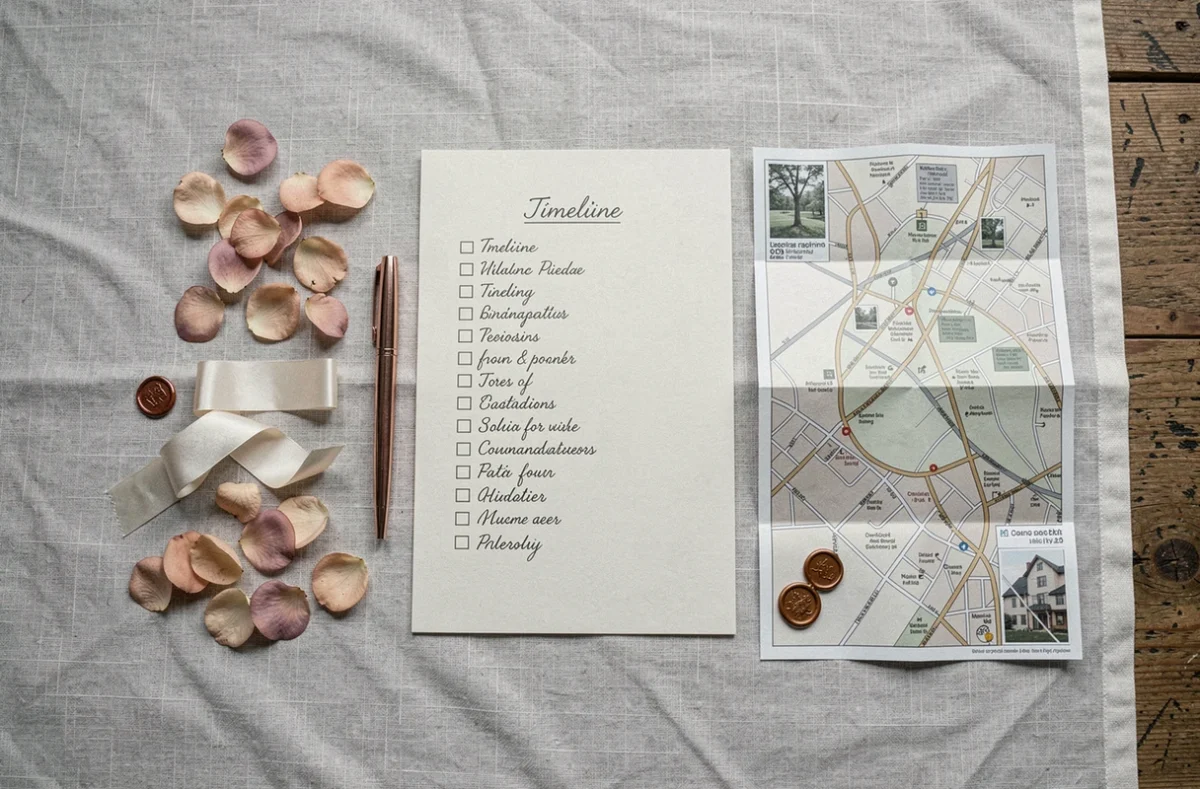
The administrative aspect of the wedding is often postponed in favor of decorative or culinary choices. The preparation of the civil marriage file follows a timeline that does not depend on the couple.
The submission of the file at the town hall must occur several weeks before the desired date. Deadlines vary by municipality: some require submission two months in advance, while others accept one month. During the summer, slots for civil ceremonies quickly become scarce.
The documents to gather (birth certificates less than three months old, proof of residence, information about witnesses) sometimes take longer than expected, especially if one of the future spouses was born abroad. Anticipating this step as soon as the date is set avoids an administrative rush a few days before the wedding.
Reception and guest experience: focusing on two or three key moments
Intimate weddings allow for concentrating the budget on high-value moments rather than spreading it over a long list of items. A cocktail bar with a mixologist, an interactive culinary workshop, or live artistic entertainment leave a stronger impression than an elaborate table decoration.
Two or three well-thought-out experiences create more memories than a dozen scattered details. Guests rarely remember the color of the napkins, but they will remember a shared moment that was out of the ordinary.
The more intimate format also simplifies logistics: fewer place settings, a less complex seating plan, shorter speaking times. The stress of the reception mechanically decreases when the number of variables to manage is reduced.
Making these choices early in the preparations, starting with the high-constraint items (venue, caterer, civil date), and then adjusting the creative elements based on the remaining budget, remains the most reliable method to arrive on the big day with a smile rather than a list of problems to solve.