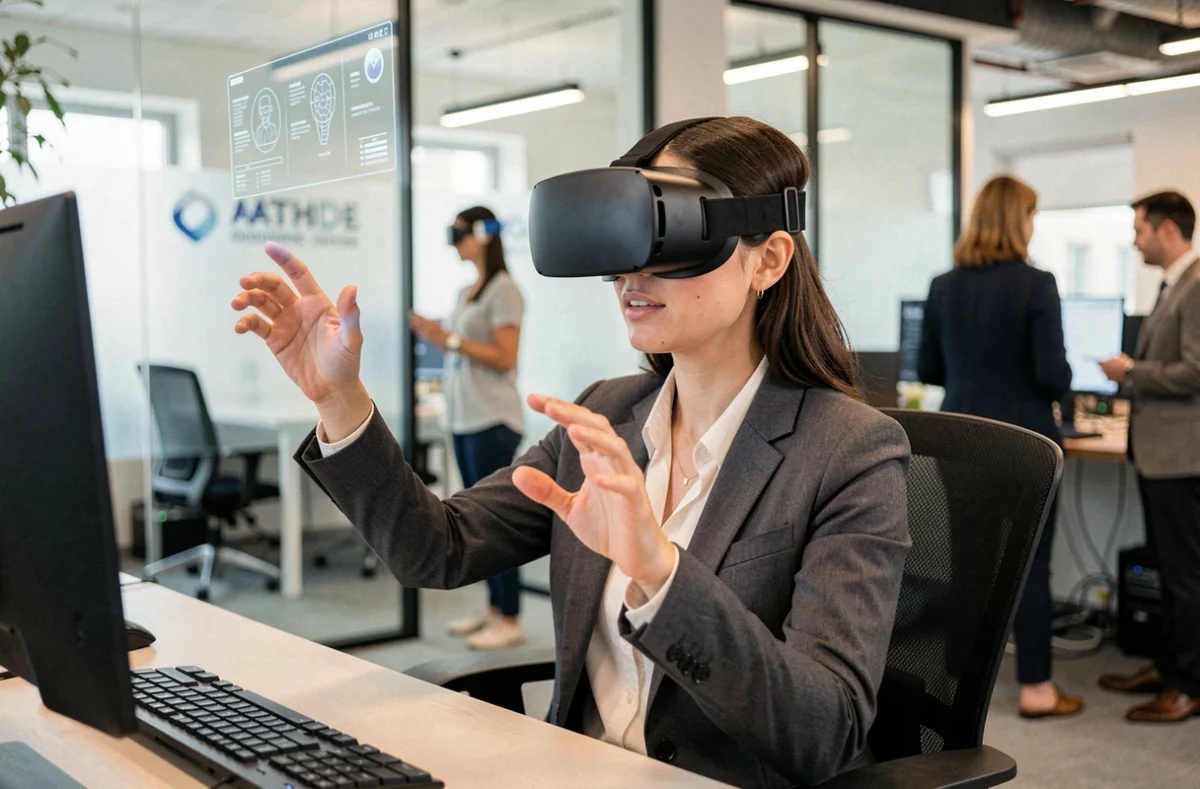
On a construction site, an operator puts on a virtual reality headset and finds himself facing an improperly secured scaffolding. He must identify the defects, secure the area, and alert his supervisor. Everything is simulated, but his heart rate is very real. This type of situational training illustrates what virtual reality training concretely brings to companies: physical and cognitive training on scenarios that cannot be replicated in a classroom.
When Virtual Reality Surpasses Traditional Training (and When It Doesn’t)
It is often said that VR is superior to any other format. The reality is more nuanced. A systematic review published in 2024, covering 30 studies, concludes that VR headsets are especially advantageous when the learner needs to manipulate or practice physically. For an activity limited to viewing or acquiring information, the advantage over a traditional screen remains minimal.
In other words, training maintenance technicians to dismantle a valve in a virtual environment makes sense. Having them watch a 360° video on the company’s values, much less so. The criterion for choice is simple: if the targeted skill involves a gesture, a decision under pressure, or spatial interaction, VR is justified. Otherwise, well-designed e-learning works just as well for less cost.
Specialized platforms like immersivelab.fr allow companies to design modules tailored to their field use cases, precisely targeting situations where immersion provides real educational added value.
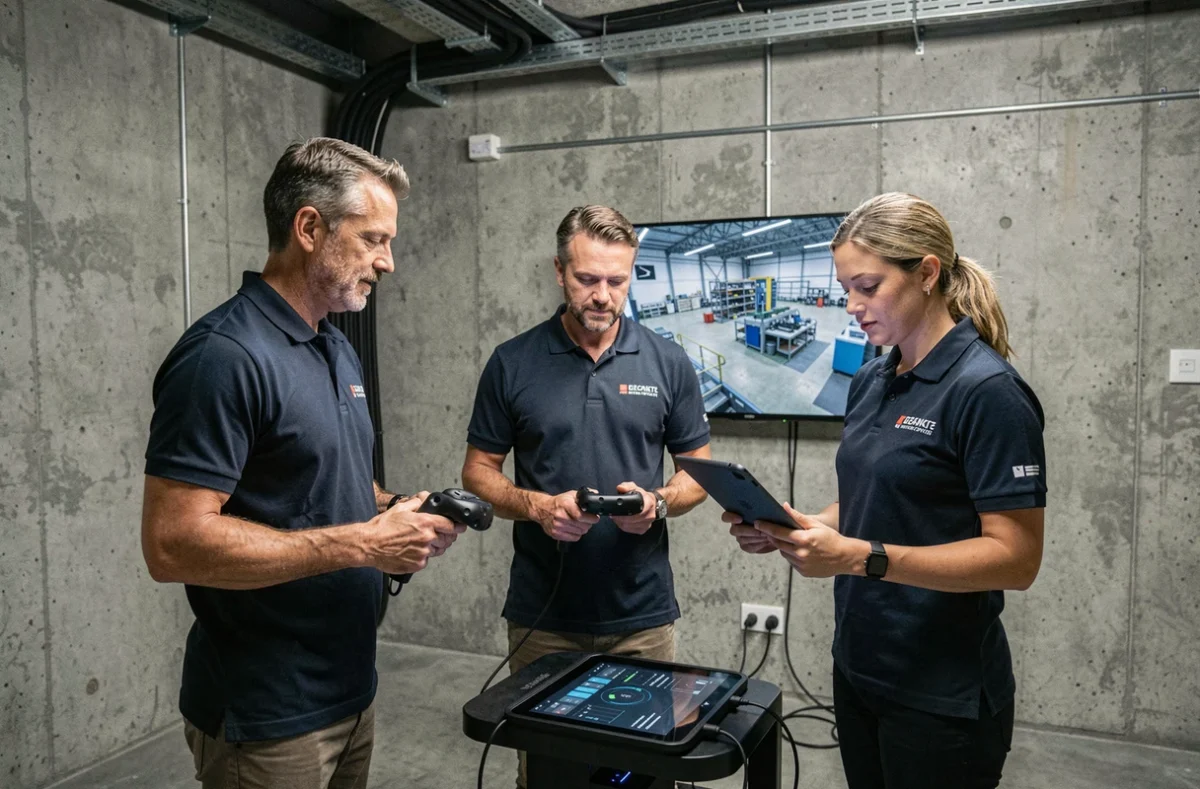
VR Training in Workplace Safety: The Most Mature Use Case
Risk prevention concentrates the majority of virtual reality deployments in companies. The reason is pragmatic: you cannot cause a real accident to train an employee to react to it.
Risk Identification and First Aid Skills
Risk identification in a virtual environment places the learner in a reproduction of their workstation. They must spot anomalies (exposed wires, missing fire extinguishers, improperly worn PPE) and apply corrective procedures. The format is more engaging than a paper photo and allows for varying scenarios without mobilizing a real site.
Some organizations now offer first responder training combining a virtual reality session with a real fire pit exercise. The VR headset is used to automate reflexes before transitioning to real conditions, which reduces stress and improves the quality of actions on the day.
Handling and Lifting
In the logistics and construction sectors, immersive training in handling and lifting is gaining ground. The learner virtually manipulates loads, identifies risky postures, and corrects their actions in real-time. This type of module meets strong regulatory constraints while limiting the risk of injury during learning.
Operational Limits of Virtual Reality Training
Deploying VR in training is not just about buying headsets. Several barriers persist, and ignoring them leads to projects being abandoned after a few months.
- Equipment Reliability and Calibration: Headsets require regular maintenance, software updates, and precise calibration. In a dusty industrial site, the lifespan of the equipment can be problematic.
- Gap Between Simulation and Real Conditions: Recent synthesis work indicates that simulated environments do not always faithfully reproduce field constraints (temperature, noise, odors), which can reduce the transferability of learning.
- Absence of Standardized Metrics: Skills are evaluated using very different methods across sectors. Comparing the effectiveness of VR training to that of a traditional setup remains difficult due to the lack of a common reference.
- Evidence of effectiveness focuses on immediate learning (level 1-2 of the Kirkpatrick model). Data on behavior change in the workplace or medium-term operational results remain scarce.
Feedback also varies depending on the trained population. Operators accustomed to digital tools adopt the headset within minutes, while others need an acclimatization period that can encroach on the useful duration of the session.
Virtual Reality and Data Protection: An Often Overlooked Angle
A VR headset collects fine behavioral data: gaze direction, reaction time, head movements, and sometimes heart rate. In a professional training context, this data is linked to an identified employee.
The GDPR fully applies to this type of processing. Before launching an immersive training program, one must ensure that the legal basis for processing is identified (legitimate interest or consent), that the data collected is proportionate to the educational objective, and that the retention period is defined. The entry into force of the European AI Act adds a layer of compliance for modules that integrate adaptive artificial intelligence.
Documenting the processing of biometric data in the GDPR register is not optional, even for a simple pilot of three sessions. Neglecting this point exposes the company to a real legal risk, not a theoretical one.
Choosing Between Virtual Reality and Augmented Reality for Training
Augmented reality (AR) overlays digital information onto the real environment via glasses or a tablet. It is suitable for situations where the learner must remain in contact with their workstation: step-by-step guidance on a machine, overlaying procedures, assisted quality control.
Virtual reality, on the other hand, completely isolates the learner in a simulated environment. This format is better suited for situational training where mistakes could have serious consequences in real conditions, or when the training location does not yet exist (factory under construction, remote site).
The choice between VR and AR depends on the degree of interaction with the real environment during learning. If the employee must act on a physical machine while learning, AR is more relevant. If one wants to simulate a complete scenario without location constraints, VR prevails.
Professional training in virtual reality is not a one-size-fits-all solution. Its effectiveness depends on the type of skill targeted, the quality of the educational scenario, and the company’s ability to maintain the system over time. Organizations that get the most out of this technology are those that target specific use cases, measure results beyond immediate satisfaction, and integrate regulatory compliance from the project’s design.